
ultimate-guide
Benefits of Variable Speed Pool Pumps: 2026 Guide
Table of Contents
- How Variable Speed Pool Pumps Cut Energy Costs
- Variable Speed Pump vs Single Speed: A Side-by-Side Comparison
- Payback Period, Rebates, and the Real Return on Investment
- Pool Pump Energy Efficiency Standards in 2026
- How to Program a Variable Speed Pool Pump
- Sizing a Variable Speed Pump for Your Pool Volume
- Troubleshooting and Smart Home Integration
- Frequently Asked Questions
Last Updated: September 21, 2026
How Variable Speed Pool Pumps Cut Energy Costs
A variable speed pool pump is a filtration pump that runs its motor at multiple rotations per minute rather than one fixed speed, so it can move water slowly for long stretches instead of blasting it for a few hours. That single design change is why the benefits of variable speed pool pumps show up first on your utility bill: pumping power scales with the cube of motor speed, so halving the RPM cuts energy consumption far more than half.
What the Kilowatt-Hour Math Actually Looks Like
Pump energy use follows the affinity laws. Power demand rises with the cube of speed, so a pump at 1,725 RPM draws roughly one-eighth the power of the same pump at 3,450 RPM. Running longer at low speed keeps your turnover rate intact while slashing kilowatt-hours. According to the U.S. Department of Energy guidance on pool pump efficiency, pool pumps are one of the largest single energy users in a home, which is why motor efficiency matters more than most owners realize.
Variable Speed Pump vs Single Speed: A Side-by-Side Comparison
The core difference is control. A single-speed pump runs at one RPM and one flow rate. A dual-speed pump offers two settings. A variable speed pump, often paired with a variable frequency drive, offers dozens of speeds you can match to each task, and that flexibility is what unlocks every downstream benefit.
| Feature | Single Speed | Dual Speed | Variable Speed |
|---|---|---|---|
| Speeds | One | Two | Many (often 8 preset + custom) |
| Typical operating RPM | ~3,450 | ~1,725 / ~3,450 | ~600-3,450 |
| Energy consumption | Highest | Moderate | Lowest |
| Noise at the pad | Loudest | Moderate | Quietest |
| Best for | Small, simple pools | Budget upgrades | Most modern pools |
Why the RPM Range Matters More Than the Label
A single-speed pump is essentially an on/off switch: it moves a fixed volume of water per minute and burns a fixed amount of power doing it. A variable speed pump lets you dial flow to the task. That matters because flow rate, not just runtime, drives how well your skimmer, filter, and heater perform.
- Low speed (roughly 600-1,200 RPM): long filtration cycles, maximum energy savings, best fine-debris capture.
- Medium speed (roughly 1,500-2,200 RPM): skimming, surface cleaning, and everyday circulation.
- High speed (roughly 2,800-3,450 RPM): vacuuming, backwashing, spa jets, and solar or heat-pump heating.
Noise, Equipment Longevity, and Water Clarity
Lower pump speed means lower decibel levels, so a variable speed pump is noticeably quieter at the equipment pad, often the difference between hearing it from the patio and not hearing it at all. Running slower also reduces plumbing resistance and mechanical wear on the motor, seal, and impeller, which extends equipment longevity. For water clarity, slower circulation lets your filter capture fine debris more effectively during each filtration cycle and gives sanitizer more contact time with the water.
Sizing the Pump to Your Pool Volume and Plumbing
This is the step most comparison articles skip, and it is where a variable speed pump either pays off or underperforms. Sizing starts with two numbers: your pool volume in gallons and your plumbing diameter.
- Calculate pool volume. For a rectangular pool: length × width × average depth × 7.48 gallons per cubic foot. A 16 ft × 32 ft pool with an average depth of 5 ft is roughly 19,150 gallons.
- Set a turnover target. Most residential pools aim for one full turnover every 8-10 hours. Divide gallons by hours to get required gallons per minute (GPM). 19,150 ÷ 8 ≈ 2,394 GPH, or about 40 GPM.
- Match GPM to plumbing. A 1.5-inch return line comfortably handles roughly 40-50 GPM; 2-inch plumbing handles more. If your plumbing is undersized, a larger pump will not help, it will just raise pressure and noise.
- Pick horsepower last. Choose the pump that hits your target GPM at a low RPM, not the biggest motor on the shelf. Oversizing wastes money up front and can force high-speed running; undersizing erases the savings.
Payback Period, Rebates, and the Real Return on Investment
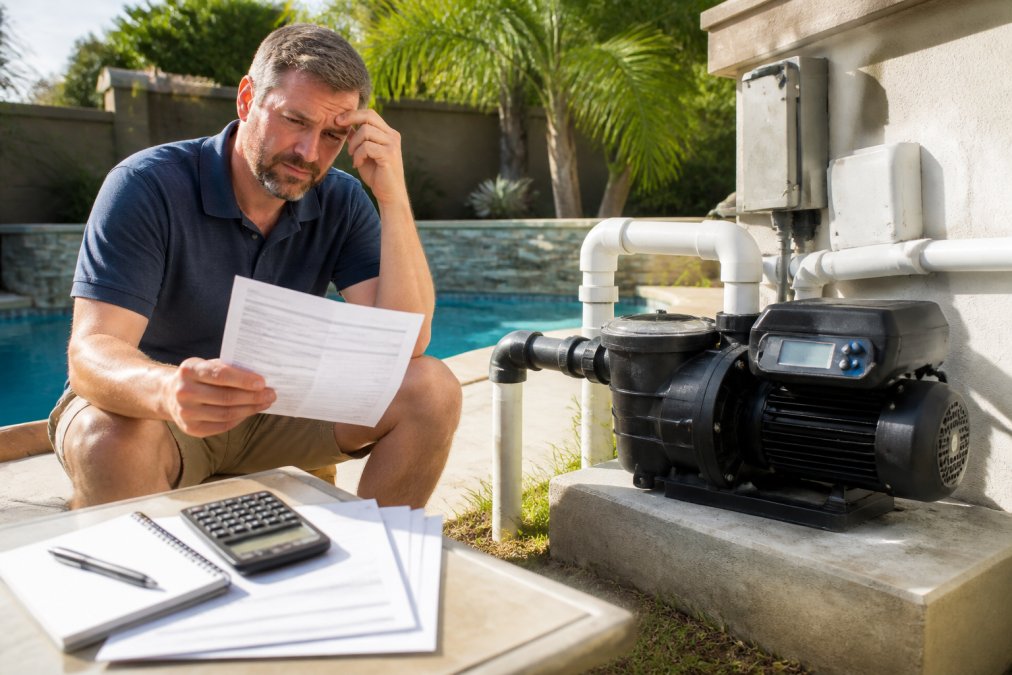
The payback period is the time it takes your annual energy savings to cover the net cost of the new pump. Because a variable speed pump uses so much less energy, many owners see that window shrink to a few seasons, but the size of the window depends on three inputs you can actually estimate before you buy.
How to Estimate Your Own Payback
- Find your current pump's wattage. Check the motor nameplate or the pump's spec sheet. A typical single-speed 1.5 HP pump draws roughly 1,500-2,000 watts at high speed.
- Estimate annual runtime. Multiply daily hours × 365. A pump running 6 hours a day runs about 2,190 hours a year.
- Convert to kilowatt-hours. Watts ÷ 1,000 × hours. A 1,750-watt pump at 2,190 hours ≈ 3,833 kWh per year.
- Apply your rate. Multiply kWh by your utility's cents-per-kWh rate to get annual cost.
- Compare against a variable speed pump. A VSP running most of the day at low speed often uses a fraction of that energy for the same turnover, so the difference is your annual savings.
- Divide net cost by annual savings. That is your payback in years.
Because pumping power scales with the cube of motor speed, the savings are not linear, running at half speed can cut power draw to roughly one-eighth, which is why the payback math usually favors a VSP even at a higher purchase price.
Rebates and Incentive Programs
Utility rebates are the single most overlooked lever in this decision, and they vary widely by region. Most programs share a few common features:
- Eligibility is tied to efficiency. Rebates typically require an ENERGY STAR certified pump or a pump meeting a minimum weighted energy factor. Check the ENERGY STAR certified pool pump listings for qualifying models.
- Proof of purchase and installation is required. Keep the invoice, model number, and sometimes a photo of the installed equipment.
- Some programs require a pre-installation application. Apply before you buy, or you may forfeit the rebate.
- Amounts vary by utility and by state. Some offer a flat dollar amount; others tier it by pump efficiency.
The Real Return on Investment
Beyond the utility bill, a variable speed pump returns value in three other ways: longer equipment life (fewer high-speed hours means less wear), quieter operation (a quality-of-life return that is hard to price but easy to notice), and lower chemical demand (better filtration means more consistent water chemistry). Add those to the energy savings and the effective ROI is usually stronger than the payback math alone suggests.
Pool Pump Energy Efficiency Standards in 2026
Federal efficiency standards now require most new pool pumps sold in the United States to meet minimum energy-performance thresholds, which has pushed single-speed pumps out of the mainstream for many residential applications. In practice, this means the equipment available to you today is already built around motor efficiency and lower operating costs. When we specify a pump, we match it to your pool's turnover rate and plumbing so the standard works in your favor rather than just on paper.
How to Program a Variable Speed Pool Pump
Programming a variable speed pump comes down to matching speed to task. Here is a common sequence for programming:
- Set a low-speed filtration schedule for the bulk of the day
- Add a medium-speed window for skimming and surface debris
- Reserve high speed for vacuuming, backwashing, or spa mode
- Adjust runtime so you complete a full turnover each day
- Lock the schedule and monitor for a week, then fine-tune
Sizing a Variable Speed Pump for Your Pool Volume
Sizing starts with pool volume and turnover rate. Measure your pool's gallons, then decide how many hours you want a full turnover to take. A larger pool or one with high plumbing resistance needs a pump that can still hit the required flow rate at low speed. Oversizing wastes money; undersizing forces high-speed running that erases the savings. Active Pools can help size a pump against your actual volume and plumbing layout, rather than relying on a generic chart.
Troubleshooting and Smart Home Integration
Most variable speed pump errors trace back to a few causes: a clogged strainer basket, a prime loss after a power interruption, a schedule that never got saved, or a communication fault between the pump and its controller. Clearing the basket and re-priming resolves most of them. Modern pumps also integrate with smart home systems, so you can adjust pump speed from an app or tie it into an automation scene.
Frequently Asked Questions
Do I really need a variable speed pool pump?
If your pump runs more than four hours a day or your electric bill has climbed, a variable speed pool pump usually pays for itself. Because it moves water at lower RPMs for longer periods, it uses far less electricity than a single-speed unit. Homeowners with older pumps often see the biggest gains, especially if the pump runs during peak utility hours.
What are the disadvantages of a variable speed pool pumps?
The main drawbacks are higher upfront cost and a steeper learning curve. Programming the schedule takes some trial and error, and repairs can cost more because the drive electronics are more complex than a basic motor. Some older pools also need plumbing adjustments to handle lower flow rates efficiently. None of these issues outweigh the long-term savings for most owners.
How many hours should you run a variable speed pool pump?
Most pools need one full turnover of their volume daily. A variable speed pump can achieve that in 8 to 12 hours at low speed instead of 4 to 6 hours at high speed. Run it longer at lower RPMs to save energy and improve filtration. Adjust based on water clarity, bather load, and season.
How much electricity does a variable speed pool pump save?
Savings depend on your old pump, utility rates, and run schedule. Because energy use scales roughly with the cube of motor speed, cutting RPM in half can reduce power draw by about 85 percent. Many owners report cutting pump-related electricity costs by 50 to 75 percent, which shortens the payback period considerably.